
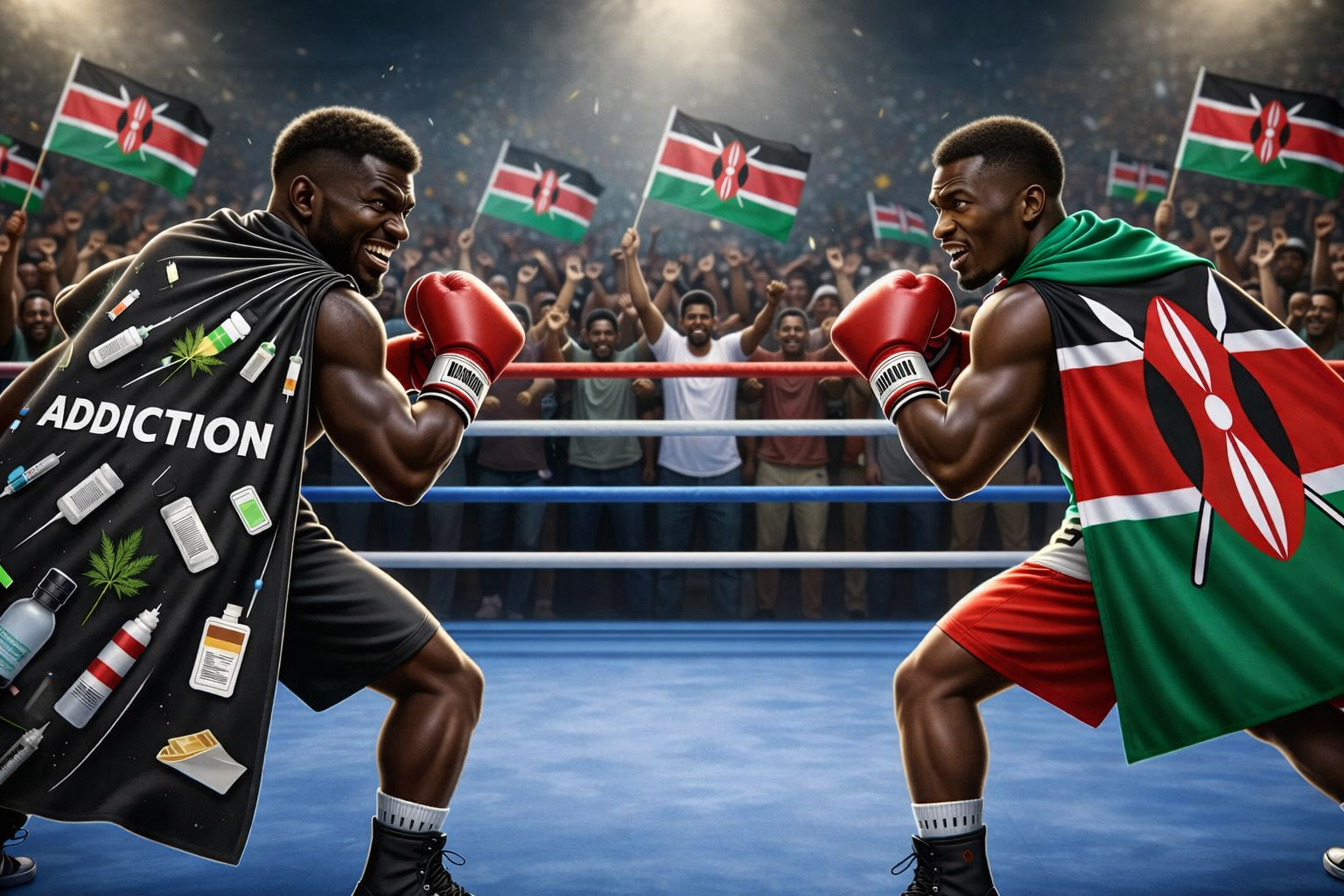
In Kenya, drugs have remained the undisputed champion in the war against drugs. But that is soon changing.
As the country prepared to usher in 2026, the president of Kenya, H.E. William Samoei Ruto proposed capital punishment for illegal alcohol and drug traffickers caught in the country. Following the lead of countries like China, Iran and Singapore which have applied the death penalty to drug traffickers, this move is meant to deter the supply of drugs within the nation and protect its most important resource – the youth, against drug and alcohol addiction. This, the president noted, is crucial if the country is to realize its dream of ‘The Road to Singapore.’ But cutting-off the supply is just one piece of the puzzle in this Title Fight. Probably more resources should be allocated in cutting-off the demand.
Data on how other countries are delivering blows on drugs, and the corresponding results, can help us as a nation make informed choices on how to approach this fight.
In 2001, Portugal took a public health-centered approach and made a radical decision to decriminalize drug use. This move resulted in a knockdown of drug use, leading to a significant reduction in drug related harms. The success of this move was largely facilitated by their robust social and health system.
Oregon tried to follow a similar approach in 2021 but ended up recriminalizing drug use just three years later. It is important to note that their social and health system dedicated to the drug war fell shy in comparison to that of Portugal, and the timing of their policy change came amidst the COVID 19 pandemic. These two factors were a low blow to the country, and may have contributed to the move not bearing the desired results.
The Philippines took their stance in the opposite direction. Shortly after taking the presidential office in 2016, Rodrigo Duterte launched his administration’s signature “war on drugs” policy, which was characterized by law enforcement, criminality and severe punishment. Duterte encouraged the police and the public to kill suspected drug dealers and users. This resulted in civilian deaths totaling to 12,000-30,000 according to human rights organizations, although the government’s official tally was just above 6,000.
From the case study of these three government policies, it is evident that harsh and extreme measures resulted in more harm than good.
In the late 1970s, a Canadian, Dr. Bruce Alexander, conducted a study known as The Rat Park Experiment. From the experiment, rats which were isolated in cages and given the option to drink water from two bottles, one with plain water, and another one laced with morphine and cocaine, almost always chose the drug water, with some rats going to the extent of killing themselves. And the rats which were in a simulated environment matching their natural one, where they could play and interact with each other, and given the same two options of drug water and plain water, almost always chose the plain water. None of the rats used the drug water compulsively. This shows that even with the supply present, the demand for drug water was significantly reduced.
In an unrelated case, a few years earlier, the US government had commissioned Dr. Lee Robins to conduct a substance use disorder(SUD) study on returning Vietnam veterans. From the study, she found that in three years, only 12% of the veterans who used heroin in Vietnam relapsed. This translated to nine out of 10 veterans getting rid of their heroin addiction.
Conclusions from these two studies shows us that connectedness and the environment are the major players that deliver successive uppercuts on addiction, significantly affecting the addiction rate. Or so it would seem. It is imperative to note that studies show that a large percentage of the veterans who had recovered from heroin use disorder, became alcoholic.
This was a catch and counter and it shows that they only ended up replacing one evil with a lesser one, but their compulsive disorder remained in place.
What we have in our hands, is a public health paradox. In the eyes of society, addiction is a problem because of the long term negative effects of the substances to the individual and the society in general. Unfortunately, for the most part, the addicted person does not share the same perception, that their substance use is a problem. This is because of the immediate positive effects they get, although some may have a hint deep down that their drug use is problematic. For the majority, at the core, the drug of choice, alcohol or otherwise, is largely a cut kit. A solution to a perceived or unknown personal root problem, probably stemming from childhood. And there lies the disconnect.
Maybe if we took a step-back and viewed this addiction topic differently, we would be one step closer to winning the fight. Maybe if we stopped looking at it as a problem and took on the view of the person that is addicted, and viewed it as an attempted solution to their perceived or unknown root problem, we would be better placed to approach it with compassion and take on a health-first approach.
In two separate stories that KTN did some time back, three cannabis users clearly explain their reasons for using, but it ends up being a comedy show for the arresting officers and the society in general. I must say though, it is really funny. But if we paused for a moment, stopped judging these people, and really listened to what they were saying, we would realize that in bhang, one user found a solution that gives him strength, assists him in his bodily functions as well as thinking. (Video Below)
The other user found a solution to anger and hate. And the other one found his solution to fear and depression. (Video Below)
Of course these are their perceived root problems, and high chances are, they go deeper than that, but we can not take that away from them, unless they themselves are able to recognize the root problem and heal the root wound. It is important to note that all three, in their own way, mentioned that smoking cannabis gave them a connection to God
The Bible is filled with some useful wisdom nuggets that we should apply in our daily lives. If you do not subscribe to the Bible, please bear with me as I make my point. Take the story of the adulterous woman who is brought before Jesus by the Scribes and the Pharisees. You can find it in John 8:1-11
In the story, Jesus tells the Pharisees and the Scribes that whoever is without sin should be the first one to throw a stone. The accusers leave one by one and no one is left to condemn her. We can draw wisdom from this story and apply it in our society today. If you have never misdiagnosed a problem, and proceeded to solve it the best way you knew how, then probably you should be the first one to throw the stone at the person who is struggling with addiction. In this case also, no one would be left to condemn them.
With this perspective in mind, can we avoid being caught cold, normalize mental health conversations and end the stigma? Each and every one of us can contribute in their own little way. Using a public health-centered approach:-
- At the very least, we can spread love instead of judgment.
- Not everyone will be able to afford rehab and counseling services, so the next best thing is, we can join hands in support of healthy and safe spaces where people can talk without fear of judgment. These can be organized individual or group therapy sessions led by trained facilitators. Instead of punishment, illegal drug abusers can be sentenced to such sessions, and alcohol and other legal drug abusers can be encouraged to attend the sessions.
- We can have regulated fun spaces and activities, where people struggling with addiction can bond and connect.
- The government can invest in harm reduction programs as well as counselling services for people who need them.
- At the core of most addiction cases, is adverse childhood experiences that led the individuals to find coping mechanisms in a bid to mend a disconnect. There might be a need to fund and conduct studies on these experiences and craft evidence based programs specific to our people. These can be implemented in universities, colleges, secondary schools, faith-based institutions, at the work place, and other common community areas, to manage and rehabilitate active cases of addiction, and help the upcoming generation find better coping mechanisms, and prevent them from going down the path of addiction.
- Drug decriminalization is at the heart of a public health-centered approach, and more research is needed to determine what will work best for us.
I would now like to address the person struggling with addiction, be it of process, substance or both.
At the individual level, and in simple terms, addiction is a yearning for connection – Spiritual, human or both. The Vietnam veteran study revealed that even though a change of environment solved their heroin addiction, the veterans proceeded to become alcoholics. Meaning that heroin or alcohol was not the problem, but rather, something deeper and unknown.
If we are to draw wisdom from the same story of the adulterous woman, while the Scribes and the Pharisees refer to Jesus as “Teacher” the woman refers to Jesus as Lord, meaning she recognized His sovereignty. She had tried to find a connection in her adultery, but missed the mark. Now when she is brought to Jesus by her accusers, she submits to His authority and finds that Spiritual connection.
Later on in the chapter, Jesus makes two eye opening statements that describe what had happened in the story. First, He tells the Jews who believe in Him that if they abide in His word, they shall know the truth and the truth shall set them free. Later on, He says that “If the son sets you free, you will be free indeed.”
From the story, no one condemns the woman, including herself, and Jesus tells her that He does not condemn her either, and that she should go and sin no more. This shows that she had believed, submitted to Jesus’s word and authority, established a Spiritual connection, had known the truth and the truth had set her free, and she was free indeed.
In order to be indeed set free from the chains of addiction, it is imperative that you establish a Spiritual connection. A complete submission to God’s authority. You will duck the hook and completely knockout addiction in your life. Otherwise, you will end up replacing one addiction with another, missing the mark while looking for that desired or predicted outcome, which is a fulfilled life free from mental torment and pain.
This is the 12th round, it is not the time to throw in the towel, it is the time for each and every one of us to tap the gloves.
Drugs are affected many young people in the community but is education for youth very important to know drugs is dangerous for life and we need to support don’t punnish
Absolutely 💯.